TRIAD Planner: Three-Level Robust Imitation Learning for Autonomous Driving
- Abstract
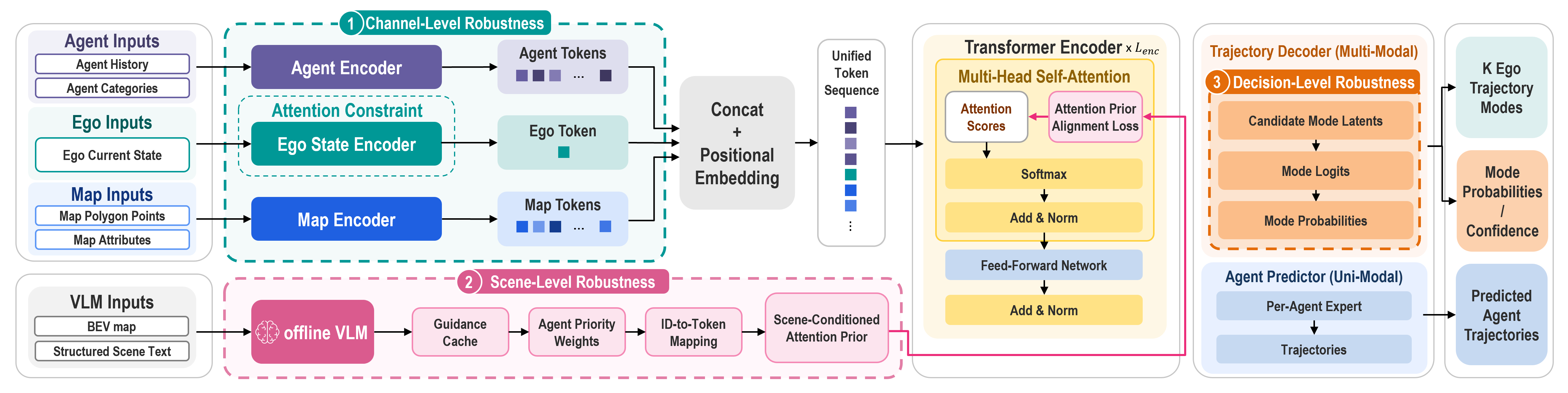
Imitation learning for autonomous driving suffers from distribution shift between logged expert trajectories and self-induced deployment states. In Transformer-based planners, this shift can appear as ego-state shortcut learning, incomplete scene understanding, and unsafe mode selection under interaction un certainty. This paper presents a robust imitation-learning planner based on a three level robustness formulation. 1) Channel-level robustness: constrained ego-state attention to reduce shortcut dependence on a small subset of state channels. 2) Scene-level robustness: offline vision-language model (VLM) guidance to encour age the ego query to retain interaction-critical agent evidence and route-relevant map evidence. 3) Decision-level robustness: training-time multimodal supervi sion reshaped with a tail-risk score based on mean excess above Value at Risk. The scene-level VLM guidance and decision-level tail-risk supervision are used only during training, and the deployed planner incurs no additional inference-time over head. On nuPlan test14, the proposed planner achieves the strongest performance among the evaluated learning-based methods and improves over CAR Planner, a strong constrained-attention imitation-learning baseline. The gains are especially pronounced on test14-hard, which contains more challenging scenarios, where NR-CLS and R-CLS change from 70.81 and 66.12 to 73.39 and 67.12, respec tively. Ablation results show that combining all three-level components yields consistent performance across diverse scenarios, supporting the effectiveness of robust imitation learning for autonomous driving.