Traffic Network-Aware Energy Management for FCEVs: Integrating Trip-Specific Control and Long-Run Optimality
- Abstract
- Additional Comments
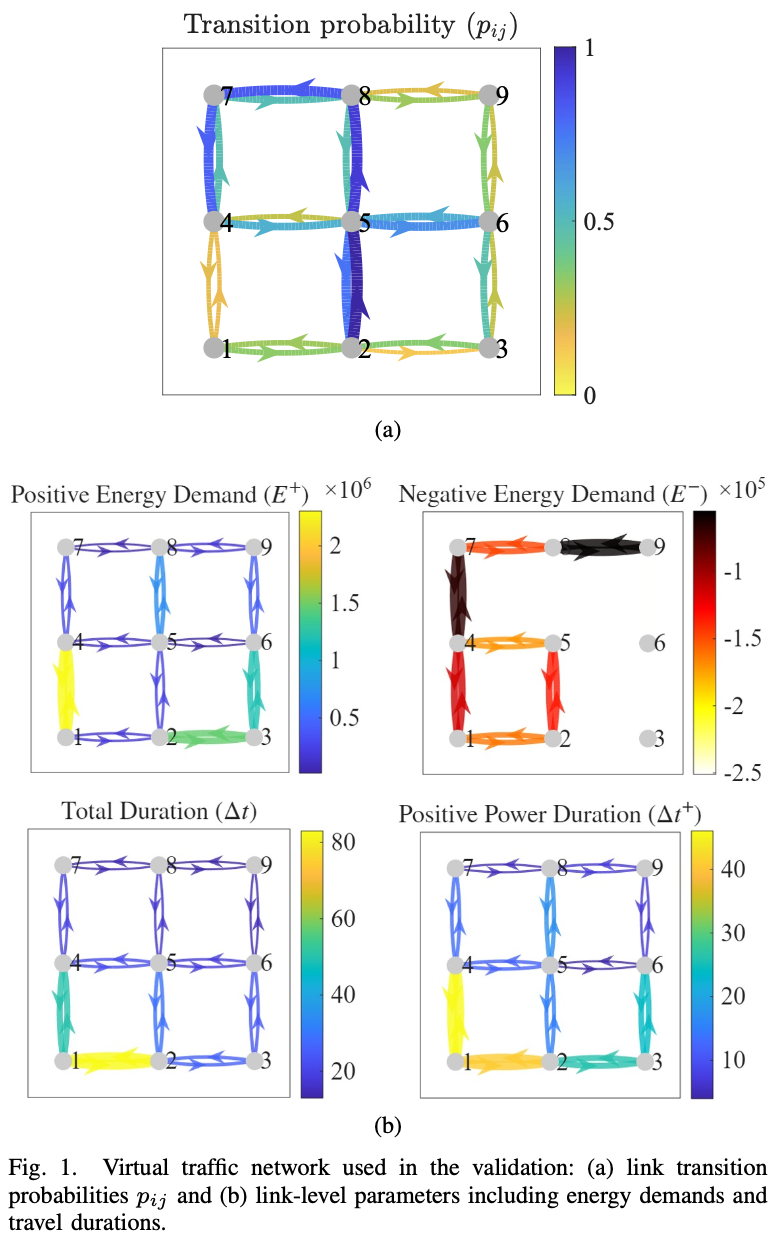
Energy management for fuel cell electric vehicles (FCEVs) is a challenging trajectory optimization problem. Conventional studies primarily focus on trip-specific optimal control, where the power distribution is optimized based on a predicted finite-horizon driving profile. However, these methods often suffer from a limited look-ahead horizon and fail to guarantee long-run optimality within the stochastic traffic network where the vehicle operates. This study proposes a novel framework that integrates finite-horizon optimal control with traffic network-aware long-run average costs. We formulate the problem by embedding the long-run optimality, derived from network-level transition probabilities, into the terminal cost of the trip-specific optimization. This approach enables an adaptive target State of Charge (SOC) that aligns with global network efficiency while satisfying immediate driving constraints. Simulation results in a virtual traffic network demonstrate that the proposed integrated strategy consistently outperforms traditional trip-specific methods, achieving a maximum performance improvement of 11%. These findings highlight the necessity of network-level statistical awareness for maximizing the long-term energy efficiency of electrified mobility.