Nonstationary Infinite-Horizon OCP
Core idea. A nonstationary infinite-horizon problem generally requires a time-indexed family of values and policies. This research seeks a sufficient context or event-based representation under which the dynamics, cost, constraints, and transition law become time homogeneous, allowing one context-conditioned critic and policy to represent long-run control.
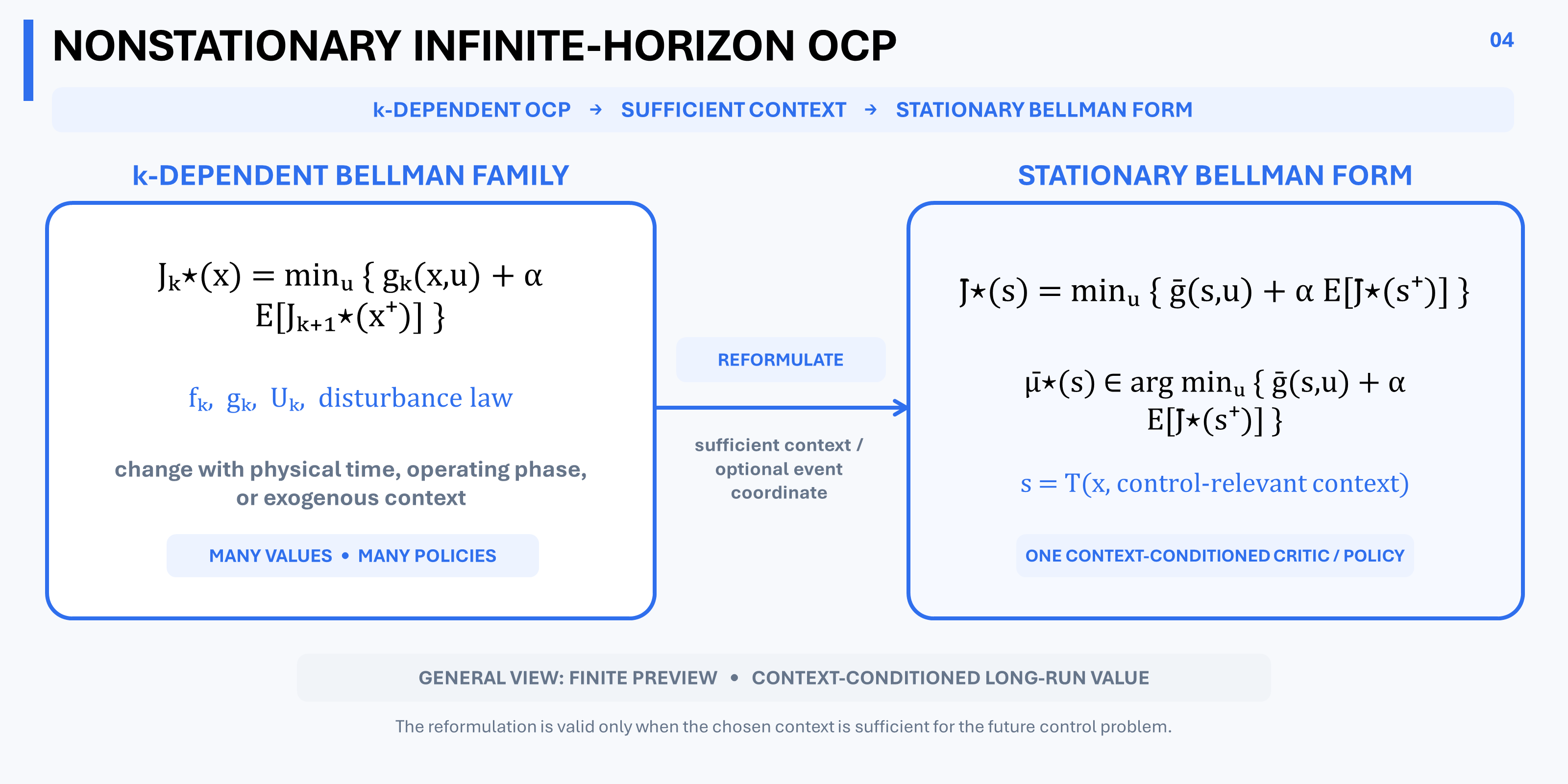
A k-dependent Bellman problem is transformed, when a sufficient context exists,
into a stationary Bellman problem on a reformulated state
The main formulation uses a discounted infinite-horizon objective with $0<\alpha<1$. A stationary reformulation is a research condition to be established, not an assumption that every nonstationary problem can be converted.
1. Problem definition
Online Learning-Based Optimal Control uses a stationary Bellman equation when the decision state, dynamics, stage cost, constraints, and uncertainty law are time homogeneous. Many mobility problems are instead written with explicit dependence on physical time, position within an operating profile, mission phase, operating mode, or exogenous context:
\[x_{k+1}=f_k(x_k,u_k,w_k), \qquad u_k\in\mathcal U_k(x_k),\]with incurred stage cost $g_k(x_k,u_k)$. Here $w_k$ is the exogenous disturbance and $\mathcal U_k(x_k)$ is the time-dependent admissible input set.
Let $\Pi_{k:\infty}$ be an admissible class of causal state-feedback policy sequences, with $u_\ell=\mu_\ell(x_\ell)$. The explicit index on $\mu_\ell$ allows known time dependence. When additional observed context is needed, it is included in the decision state as in Section 5. The time-indexed optimal value is
\[J_k^\star(x) := \inf_{\mu_{k:\infty}\in\Pi_{k:\infty}} \mathbb E \!\left[ \left. \sum_{j=0}^{\infty} \alpha^j g_{k+j}(x_{k+j},u_{k+j}) \right| x_k=x \right],\]with Bellman recursion
\[\begin{aligned} J_k^\star(x) &= \min_{u\in\mathcal U_k(x)} \left\{ g_k(x,u) + \alpha \mathbb E \!\left[ J_{k+1}^\star(x^+) \mid x,u,k \right] \right\},\\ \mu_k^\star(x) &\in \arg\min_{u\in\mathcal U_k(x)} \left\{ g_k(x,u) + \alpha \mathbb E \!\left[ J_{k+1}^\star(x^+) \mid x,u,k \right] \right\}. \end{aligned}\]Here $x^+$ denotes the successor state. The dynamic-programming principle does not require stationarity: a nonstationary finite-horizon recursion is anchored by a terminal condition, while the infinite-horizon version is a time-indexed Bellman family. Its validity requires a well-posed discounted limit—such as bounded costs with an appropriate boundedness or transversality condition—and the future sequence of models, costs, constraints, or its probabilistic law.
Because $f_k$, $g_k$, $\mathcal U_k$, or the disturbance law can change with $k$, a single $J^\star(x)$ and $\mu^\star(x)$ generally cannot represent the exact optimum. An approximate or robust stationary policy may still be useful under declared conditions. The exact recursion is nevertheless a coupled sequence of Bellman equations, not one stationary fixed-point equation. If the $k$-dependence is unknown or drifting rather than known in advance or generated by an observed Markov context, the recursion is not directly implementable. The research problem is then to determine whether its control-relevant cause can be represented as part of a sufficient decision state.
2. Why this problem matters
In predictive control, the reference, demand, constraints, dynamics, or disturbance statistics may vary with operating phase and available preview. A critic trained only on physical state $x$ may then assign the same value to two situations that share $x$ but face different future opportunities, constraints, or costs. This context aliasing can prevent a stationary policy defined on $x$ alone from representing the exact optimum, although an approximate or robust policy may remain useful under stated conditions.
Finite-preview receding-horizon control can exploit the currently available prediction, but it does not by itself represent the continuation beyond that preview or recurring operation under future contexts. A valid stationary reformulation could support a reusable long-run critic and terminal value while retaining the context required for correct decisions.
Some apparent nonstationarity is therefore a state-representation problem: if a finite-dimensional Markov context captures all relevant $k$-dependence and evolves under a time-homogeneous law, the augmented problem is stationary. If no such context exists, or its transition law itself drifts, the original time-indexed problem remains nonstationary.
3. Key challenges
- Sufficient context and equivalence: the selected reference-generator, operating-phase, environment, mode, or task variables must preserve feasible decisions, causality, and accumulated cost without requiring the complete history.
- Coordinate or event aggregation: changing from time samples to phases, segments, cycles, or decision events can lose within-event information; aggregated transitions, costs, constraints, and discounting must preserve the original problem.
- Dimension and coverage: a richer augmented state increases value-learning complexity and requires data across the relevant contexts.
- Changing context statistics: a critic built for a fixed transition law can become invalid under distribution shift; convergence on the reformulated model does not prove that the reformulation remains correct.
4. A conventional approach — finite-preview predictive control
An exact treatment retains the $k$ index and computes the family ${J_k^\star,\mu_k^\star}$. Over an unbounded horizon this is rarely reusable or computationally practical. A common alternative solves an $H$-stage problem using the model, cost, constraints, and forecasts available at the current decision time:
\[V_{k,H}^{\mathrm{pred}}(x) = \inf_{\pi_{k:k+H-1}\in\Pi_{k,H}} \mathbb E \!\left[ \left. \sum_{j=0}^{H-1} \alpha^j g_{k+j}(x_{k+j},u_{k+j}) + \alpha^H V_{f,k+H}(x_{k+H}) \right| x_k=x \right],\]subject to the predicted $k$-dependent dynamics and constraints. Here $\Pi_{k,H}$ is a declared class of causal finite-horizon policies; each policy maps the information available at its prediction stage to $u_{k+j}$. Deterministic MPC commonly reduces this to an input-sequence optimization. The controller applies the first action and repeats the problem in receding-horizon fashion as new state and preview information become available.
If the task truly terminates after $H$ stages with a valid terminal condition, the finite-horizon formulation can be exact. For continuing operation, its quality depends on the forecast, prediction horizon, and terminal approximation $V_{f,k+H}$; a fixed $V_f$ is a special case. Unless the terminal term correctly represents the continuation, the controller can remain short-sighted beyond the preview window. A context-free terminal target can also be inappropriate when slow, stored, or resource states should be preserved differently under different future contexts. Finite-preview control is therefore a practical baseline, not by itself a solution to the original nonstationary infinite-horizon problem.
5. Research direction — context- or event-based stationary reformulation
Context-augmented stationary form. First preserve the physical decision index $k$. Suppose an observed or predictable context $c_k$ and augmented state $z_k=(x_k,c_k)$ can be constructed such that
\[\Pr \!\left( z_{k+1}\mid z_{0:k},u_{0:k} \right) = \overline P \!\left( z_{k+1}\mid z_k,u_k \right),\]and the stage cost and feasible set admit time-independent representations:
\[g_k(x,u) = \overline g\!\left((x,c_k),u\right), \qquad \mathcal U_k(x) = \overline{\mathcal U}\!\left((x,c_k)\right).\]The context may be an operating phase, mode, reference-generator state, exogenous Markov state, or another finite sufficient statistic of the available preview. Merely appending the absolute clock does not provide a useful reusable representation unless the resulting context and its future law are compact, time homogeneous, and learnable.
The stationary Bellman problem on the augmented state is
\[\begin{aligned} \overline J^\star(z) &= \min_{u\in\overline{\mathcal U}(z)} \left\{ \overline g(z,u) + \alpha \mathbb E \!\left[ \overline J^\star(z^+)\mid z,u \right] \right\},\\ \overline\mu^\star(z) &\in \arg\min_{u\in\overline{\mathcal U}(z)} \left\{ \overline g(z,u) + \alpha \mathbb E \!\left[ \overline J^\star(z^+)\mid z,u \right] \right\}. \end{aligned}\]For an augmented decision state, write $J_k^\star(x;c)$ and $\mu_k^\star(x;c)$ for the value and policy conditional on observed context $c$. Under an exact sufficient reformulation,
\[J_k^\star(x;c_k) = \overline J^\star(x,c_k), \qquad \mu_k^\star(x;c_k) = \overline\mu^\star(x,c_k).\]The semicolon makes the currently observed context explicit. When $c_k$ is a deterministic function of $k$, this reduces to the earlier notation $J_k^\star(x)$ and $\mu_k^\star(x)$. Thus one critic exists on $(x,c)$, not on $x$ alone. Under the well-posedness conditions in Section 1, value iteration or approximate DP can target this critic only if the augmented transition law is stationary and the chosen context is Markov-sufficient over the declared operating domain.
Optional event-coordinate form. When decisions naturally occur at phases, tasks, segments, or other events, the problem may instead be re-indexed at event boundaries. Let $z$ be the augmented boundary state, $a$ an event-level decision, $G$ the discounted cost accumulated until the next boundary, and $D$ the corresponding duration in physical steps. The essential Bellman form is
\[\overline J_{\mathrm{ev}}^\star(z) = \min_{a\in\mathcal A_{\mathrm{ev}}(z)} \mathbb E \!\left[ G + \alpha^D\overline J_{\mathrm{ev}}^\star(z^+) \mid z,a \right].\]Here $\mathcal A_{\mathrm{ev}}(z)$ is the admissible event-decision set, and $a$ may be one action or a declared causal policy within the event. The conditional law of $(G,D,z^+)$ given $(z,a)$ must be time homogeneous, and the aggregation must preserve within-event feasibility and path constraints. A fixed discount per event is not equivalent when $D$ varies. Under exact aggregation, the boundary value agrees with the original time-indexed value at the same physical boundary.
Use as a terminal value. Once an exact or approximate stationary long-run critic is available, it can replace the generic terminal approximation $V_{f,k+H}$ in the finite-preview predictive controller of Section 4. With an exact reformulation, model, constraints, terminal critic, and optimization, its first action is Bellman-consistent with the infinite-horizon optimum. An approximate critic does not provide that guarantee automatically. This is the connection to Online Multistep Lookahead: the present Theme asks when a reusable stationary terminal-value problem exists, whereas lookahead addresses online action improvement using a fixed critic.
6. Application domains
- Forecast-driven predictive control: represent recurring reference, demand, disturbance, constraint, or environment patterns through a sufficient context so that a finite-preview controller can use a reusable continuation value.
- Periodic or mission-phase control: augment the physical state with a finite phase or operating-mode variable when it is Markov-sufficient. This can replace separate time-indexed policies with one stationary critic and policy across recurring drive cycles, duty cycles, or mission phases.
- Event-based and networked decisions: re-index control at task phases, service events, road segments, charging nodes, or other decision boundaries. The event model must preserve accumulated cost, constraints, and physical duration.
- xEV energy and thermal management: the 2026 ASCC FCEV study is one concrete application in which road links provide event coordinates and a long-run network-conditioned value supplies continuation beyond the finite prediction window. This example motivates, but does not define, the general Research Theme.
References
- Kyunghwan Choi, “Traffic Network-Aware Energy Management for FCEVs: Integrating Trip-Specific Control and Long-Run Optimality,” Asian Control Conference (ASCC), 2026. Full text