Structured Critic Adaptation
Core idea. Structured Critic Adaptation estimates the current environment parameter online and uses it to reconfigure a stored base critic. The reconfigured critic then supports policy improvement, so an environmental change need not trigger unconstrained relearning of the full critic.
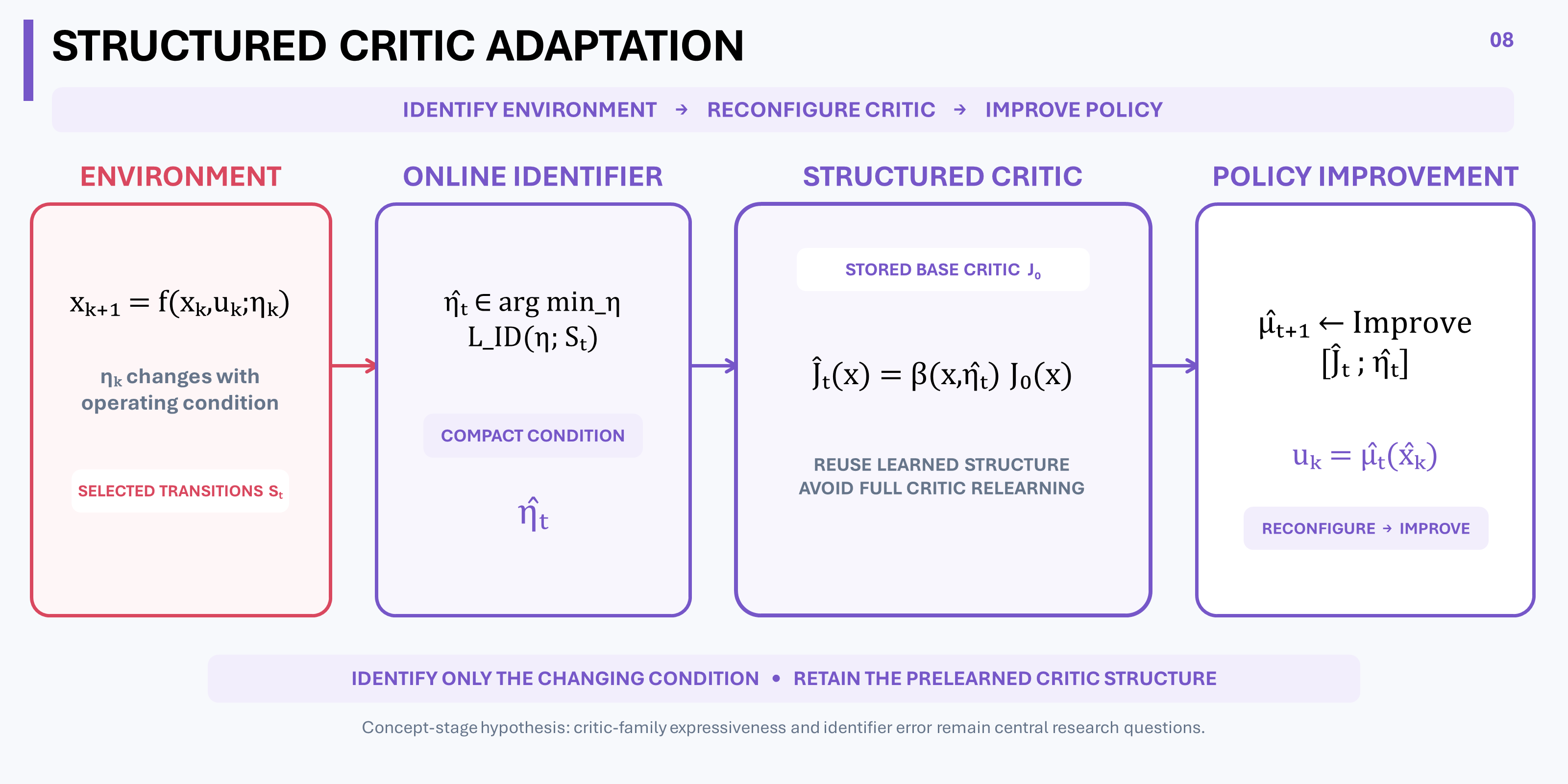
Selected transitions identify the environment,
a learned structure reconfigures a stored critic, and the resulting critic improves the policy.
Physical interaction is indexed by $k$, whereas identification and policy updates are indexed by $t$. The environment parameter $\eta_k$ may vary with physical conditions; $\widehat\eta_t$ is the estimate available at learner update $t$, and $k(t)$ is the latest physical sample associated with that update. Identification from a window assumes that $\eta_k$ is constant or slowly varying over that window, or explicitly models its evolution.
1. Problem definition
Online Learning-Based Optimal Control requires a critic appropriate to the current decision problem. Consider a family of environments
\[x_{k+1} = f(x_k,u_k;\eta_k)+w_k, \qquad y_k=h(x_k)+v_k,\]where $x_k$, $u_k$, and $y_k$ are the state, control input, and measurement; $f$ and $h$ are the state-transition and measurement maps; and $w_k$ and $v_k$ represent process and measurement uncertainty. The compact parameter $\eta_k$ represents control-relevant changes in dynamics and, when declared, in the stage cost $g$ or constraints. For notational simplicity, assume the state is available; otherwise, an estimator supplies $\widehat x_k$.
Unless the evolution of $\eta_k$ is included in a Markov decision state, a condition-specific critic $J_\eta$ below refers to the problem with $\eta$ fixed over its value horizon. Material variation over that horizon instead requires a nonstationary formulation such as Nonstationary Infinite-Horizon OCP.
Let the transition record and the set selected at learner update $t$ be
\[d_k = (x_k,u_k,g_k,x_{k+1}), \qquad g_k := g(x_k,u_k;\eta_k), \qquad \mathcal S_t = \{d_k:k\in\mathcal I_t\},\]where $\mathcal I_t$ is the selected set of physical transition indices. These recent transitions support online identification:
\[\widehat\eta_t \in \arg\min_{\eta} \mathcal L_{\mathrm{id}}(\eta;\mathcal S_t).\]The loss $\mathcal L_{\mathrm{id}}$ must declare which effects identify $\eta$: transition residuals when $\eta$ changes the dynamics, observed costs when it changes the objective, or constraint/activity information when it changes feasibility. A parameter that affects only an unobserved cost or constraint cannot be identified from state transitions alone. The single $\widehat\eta_t$ formulation assumes local constancy or sufficiently slow variation over $\mathcal I_t$; otherwise, a trajectory-valued condition model is required.
Let $J_0$ be a stored approximate base critic for a declared reference condition $\eta_0$, and let $\beta_\omega(x,\eta)$ be a structural map learned over representative conditions. The current critic is reconfigured as
\[\widehat J_t(x) := \beta_\omega(x,\widehat\eta_t)J_0(x),\]and then used for policy improvement:
\[\widehat\mu_{t+1} \leftarrow \operatorname{Improve} \!\left[ \widehat J_t;\widehat\eta_t \right].\]The generic $\operatorname{Improve}$ operator may denote a declared model-based Bellman improvement or a policy-network update. One-step lookahead is therefore a possible implementation, not part of the Theme definition. Here adaptation means reconfiguration through the identified condition, not unrestricted online retraining of all critic parameters. The multiplicative $\beta_\omega J_0$ form is the current schematic hypothesis; additive corrections or critic-bank interpolation require separate definitions.
2. Why this problem matters
Direct adaptive-DP updates can repeatedly modify the full critic whenever the operating condition changes. Such updates may fit the current condition while overwriting behavior useful under earlier conditions, so a recurring condition can require relearning.
If the environment family is organized by an identifiable parameter $\eta$, a prelearned relation from $(x,\eta)$ to critic shape can reuse structure across conditions. Online computation is then concentrated on estimating $\eta$ and improving the policy from the reconfigured critic. This is a conditional opportunity, not a guaranteed speedup: it depends on identifiability, offline coverage, and the expressiveness of the critic family.
3. Key challenges
- Environment representation and identification: $\eta$ must capture control-relevant variation and be identifiable from the limited, policy-dependent data in $\mathcal S_t$.
- Structured-family expressiveness: the family $\beta_\omega(x,\eta)J_0(x)$ may be too restrictive, especially near zeros or sign changes of $J_0$.
- Error propagation and changing conditions: identification delay, structural approximation error, stale parameters, and model error perturb both the critic and the improved policy.
- Bellman and closed-loop consistency: a plausibly shaped critic is not automatically Bellman-consistent, stabilizing, constraint-satisfying, or reliable outside the representative offline conditions.
4. A conventional approach — direct critic adaptation
A conventional adaptive-DP realization updates critic parameters directly from recent data and then improves the policy:
\[\begin{aligned} \theta_{t+1} &\approx \arg\min_{\theta} \mathcal L_{\mathrm{critic}}(\theta;\mathcal S_t),\\ \widehat\mu_{t+1} &\leftarrow \operatorname{Improve} \!\left[ \widehat J_{\theta_{t+1}} \right]. \end{aligned}\]One representative choice for $\mathcal L_{\mathrm{critic}}$ is a sampled one-step TD loss. Holding the target critic $\widehat J_{\bar\theta_t}$ fixed during learner update $t$ and taking $0<\alpha<1$, define
\[\begin{aligned} y_{k,t}^{\mathrm{TD}} &= g_k + \alpha \widehat J_{\bar\theta_t}(x_{k+1}),\\ \mathcal L_{\mathrm{critic}}(\theta;\mathcal S_t) &= \frac{1}{|\mathcal S_t|} \sum_{k\in\mathcal I_t} \left( \widehat J_\theta(x_k) - y_{k,t}^{\mathrm{TD}} \right)^2. \end{aligned}\]This form evaluates the policy that generated the transitions, subject to the usual on-policy or correction assumptions. If $\mathcal S_t$ mixes behavior policies or materially different environment conditions, the window must be restricted or an explicit off-policy/condition correction must be supplied. If a model and action minimization are available, an empirical Bellman-optimality target can be used instead. The selected critic loss and its policy-evaluation or policy-improvement role must be declared.
This can track the currently visited condition, but it does not explicitly preserve a reusable relation between the environment parameter and critic shape. Under limited data, it may repeatedly overwrite and relearn critic behavior as conditions change. This is a baseline mechanism, not a claim that every direct critic update necessarily forgets.
5. Candidate direction — identifier-conditioned critic reconfiguration
Offline, suppose approximate critics ${\widehat J^{(m)}}$ are available for representative conditions ${\eta^{(m)}}$ under a common state representation, objective, discount, and solution concept. In the optimal-control case, $\widehat J^{(m)}\approx J_{\eta^{(m)}}^\star$, where $J_\eta^\star$ denotes the optimal critic for the fixed-condition problem. Hold the reference critic $J_0$ fixed and fit the structural map through
\[\omega^\dagger \in \arg\min_{\omega} \sum_m \left\| \widehat J^{(m)}(\cdot) - \beta_\omega(\cdot,\eta^{(m)})J_0(\cdot) \right\|_{\nu_m}^{2},\]where $\nu_m$ is a declared weighting distribution or measure over control-relevant states and $|e|{\nu_m}^2:=\int |e(x)|^2\,d\nu_m(x)$. If $J_0$ is to be learned jointly instead, it must appear as an optimization variable and a normalization is needed to remove the scaling ambiguity between $J_0$ and $\beta\omega$. Online operation then follows
\[\mathcal S_t \xrightarrow{\text{online identification}} \widehat\eta_t, \qquad \widehat J_t(x) = \beta_{\omega^\dagger}(x,\widehat\eta_t)J_0(x), \qquad \widehat\mu_{t+1} \leftarrow \operatorname{Improve} \!\left[ \widehat J_t;\widehat\eta_t \right].\]A useful diagnostic, rather than a guarantee, separates two critic errors. For compactness, let $\eta_t:=\eta_{k(t)}$ denote the physical environment condition associated with learner update $t$. The norm below must use the same declared control-relevant domain or measure for all terms:
\[\begin{aligned} \left\| \widehat J_t-J_{\eta_t}^{\star} \right\| \le {}& \left\| \beta_{\omega^\dagger}(\cdot,\widehat\eta_t)J_0 - \beta_{\omega^\dagger}(\cdot,\eta_t)J_0 \right\|\\ &+ \left\| \beta_{\omega^\dagger}(\cdot,\eta_t)J_0 - J_{\eta_t}^{\star} \right\|. \end{aligned}\]The first term audits sensitivity to identification error; the second audits the structured critic family. Policy-improvement and model errors remain additional. Research questions include how to select $\eta$, how to learn $J_0$ and $\beta_\omega$, when an additive or critic-bank structure is more appropriate, how to represent uncertainty in $\widehat\eta_t$, and when to reject reconfiguration in favor of a safe fallback.
Future evidence should compare a fixed $J_0$, direct critic adaptation, the structured method with oracle $\eta$, and the method with estimated $\eta$. Relevant metrics include identification error and delay, critic and Bellman error, closed-loop performance, violations, update latency, memory, and return-to-prior-condition performance under abrupt, gradual, recurring, and held-out conditions.
6. Application domains
- Mobility controllers under changing mass, load, road–tire condition, temperature, or component aging: estimate a compact condition parameter and reconfigure a stored critic so recurring operating regimes can reuse previously learned long-run control structure.
- Electric-drive and mechatronic control with compact identifiable plant parameters, such as resistance, inertia, friction, or load, that can condition a reusable critic family and its subsequent policy improvement.
- Systems that revisit a finite or smoothly parameterized environment family: recover or interpolate an appropriate critic when a known condition returns, rather than relearning the full value function from the latest trajectory. The benefit depends on identification quality and offline coverage of that environment family.